
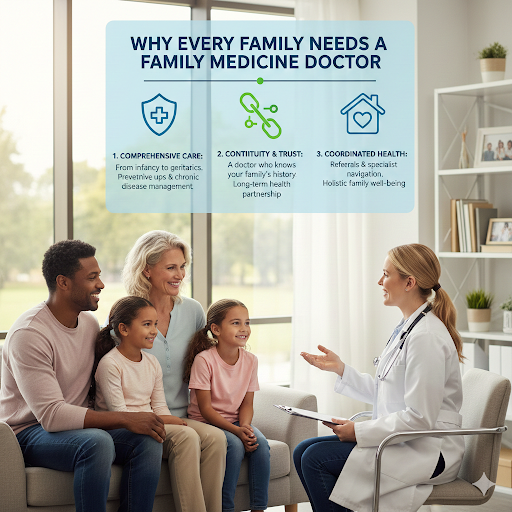
Imagine trying to solve a jigsaw puzzle, but you've hired different people to work on different sections, and none of them can see what the others are doing. That's essentially what happens when you see multiple specialists without a family doctor coordinating your care. Let's explore why this matters more than you might think.
The Fundamental Difference in Approach:-
When you understand how specialists and family doctors are trained, you begin to see why their approaches differ so dramatically. A cardiologist spends years becoming exceptionally skilled at understanding the heart and cardiovascular system. An endocrinologist becomes an expert in hormones and metabolism. A gastroenterologist masters the digestive system. This deep, focused expertise is absolutely valuable and sometimes necessary.
However, here's what often gets overlooked: specialists are trained to excel within their particular domain, which means they naturally view your health through that specific lens. A cardiologist sees your body primarily through the question "what's happening with this person's heart?" An endocrinologist asks "what's happening with their hormones?" Each specialist is solving for their particular piece of the puzzle.
A Family medicine doctor, in contrast, is trained specifically to see the complete picture. Their entire medical education and residency focuses on understanding how all the body's systems interact with each other, how your mental health affects your physical health, how your lifestyle choices ripple through everything, and how your social circumstances impact your medical outcomes. They're trained to ask "what's happening with this person as a whole human being?"
Think of it this way:-
Specialists are like master craftspeople who each create beautiful individual furniture pieces. A family doctor is like an interior designer who understands how all those pieces need to work together in your actual living space, considering not just beauty but function, your daily routines, your budget, and your future needs. Both roles are important, but they serve fundamentally different purposes.
The Hidden Cost of Fragmented Care:-
Let's walk through what typically happens when someone manages their health by seeing multiple specialists without a coordinating family doctor. You might see a cardiologist for your blood pressure, an endocrinologist for your diabetes, and a gastroenterologist for your digestive issues. Each doctor prescribes medications based on their specialty.
Your cardiologist prescribes a beta blocker for blood pressure. Your endocrinologist adds metformin and another diabetes medication. Your gastroenterologist prescribes something for acid reflux. Now you're taking five or six medications, and here's where things get complicated: some of these medications might interact with each other in ways that no single specialist is tracking. One medication might be causing a side effect that another specialist is then treating as a separate condition with yet another medication.
More importantly, nobody is asking the bigger questions. Why do you have high blood pressure, diabetes, and digestive issues all at once? These conditions don't typically arise in isolation—they're often connected through underlying factors like chronic stress, sleep problems, dietary patterns, or metabolic dysfunction. A specialist treating one condition might inadvertently make another condition harder to manage, simply because they're not looking at the full picture.
Real Example: Rajesh's Journey
Rajesh came to us after seeing three different specialists for two years. His diabetes numbers kept getting worse despite taking four medications. His blood pressure was poorly controlled despite two blood pressure medications. He had chronic fatigue that nobody could explain. When we looked at his complete medication list and health history, we discovered that one of his diabetes medications was interfering with his blood pressure control, and the combination of all his medications was causing the fatigue he complained about.
More importantly, nobody had ever asked about his complete lifestyle. We discovered he was working night shifts, sleeping poorly, eating irregular meals, and under enormous stress from family responsibilities. These factors were driving all his health problems, but each specialist had only addressed symptoms within their narrow domain. Within six months of comprehensive lifestyle changes coordinated with carefully adjusted medications, his diabetes improved dramatically, his blood pressure normalized, and his energy returned. He's now on two medications instead of six.
Continuity of Care: The Power of Being Known:-
There's something profoundly important about having one doctor who knows your complete health story over time. When you see multiple specialists occasionally, each appointment starts almost from scratch. They review your chart, ask standard questions, and make decisions based on that limited snapshot of who you are.
A family doctor who sees you regularly develops something much richer: a deep understanding of you as a person. They know not just your medical history but your patterns. They know that when you say you're "fine," you're actually struggling. They notice subtle changes that might signal early problems before they become serious. They understand your family dynamics, your work stress, your financial constraints, and how these factors realistically affect what health interventions will actually work for you.
This continuity creates something specialists simply cannot provide: the ability to see trends and connections over time. Your family doctor notices that your blood sugar always spikes during certain months and remembers that's when your work stress peaks. They see the connection between your worsening sleep and your rising blood pressure. They recognize that your recurring stomach problems correlate with relationship stress, not just diet.
The Research Backs This Up:-
Studies consistently show that patients who have an ongoing relationship with a family doctor have better health outcomes, spend less money on healthcare, take fewer unnecessary medications, get appropriate preventive care, and report higher satisfaction with their healthcare experience compared to those who primarily see specialists without a coordinating physician.
Prevention: The Critical Advantage:-
Specialists excel at treating problems within their domain once those problems exist. But family medicine's greatest strength lies in prevention—stopping problems before they start or catching them early when they're far easier to address.
Think about Type 2 diabetes. By the time most people are diagnosed and sent to an endocrinologist, they've likely had elevated blood sugar for years, and their body has already experienced damage. A family doctor seeing you regularly for general check-ups would have noticed concerning trends in your blood sugar years earlier, when lifestyle changes alone might have prevented diabetes entirely. They would have understood your risk factors, discussed prevention strategies, and monitored you closely.
The same principle applies to heart disease, many cancers, chronic kidney disease, and numerous other conditions. When you see specialists only after problems develop, you've missed the entire window where prevention was possible. Family doctors are specifically trained in this preventive approach because they see patients across all stages of health, not just when problems arise.
When Specialists Are Essential (And How Family Doctors Help)
Now, it's crucial to understand that this isn't about choosing between a family doctor and specialists. The most effective healthcare involves both, with your family doctor serving as the coordinator and guide.
When you need specialized care—say, you need heart surgery, treatment for a complex autoimmune condition, or management of advanced kidney disease—specialists are absolutely essential. Their deep expertise in specific areas is invaluable. What makes the difference is having a family doctor who can identify when specialist care is needed, refer you to the right specialists, communicate with those specialists about your overall health picture, help you understand their recommendations in context, and integrate specialist care into your broader health management.
This coordination is where the magic happens. Your family doctor can tell your cardiologist about medications you're taking for other conditions. They can help your endocrinologist understand why certain dietary changes might be challenging given your digestive issues. They can recognize when recommendations from different specialists conflict with each other and help navigate those conflicts. They serve as your advocate and interpreter, making sure all the pieces of your care fit together sensibly.
The Lifestyle Medicine Advantage
Here's something that often surprises people: family medicine doctors are kuniquely trained in lifestyle medicine—understanding how to use diet, exercise, sleep, stress management, and behavioral changes as primary treatments rather than afterthoughts.
Specialists certainly recognize the importance of lifestyle factors, but their training focuses primarily on medical and surgical interventions within their specialty. A family doctor, however, is trained to start with lifestyle approaches when appropriate. This matters enormously because many common conditions—Type 2 diabetes, hypertension, high cholesterol, fatty liver disease, many digestive disorders—often respond dramatically to lifestyle interventions, sometimes to the point where medications become unnecessary.
For example, many patients with Type 2 diabetes can achieve normal blood sugar levels through specific dietary changes and weight loss, essentially putting their diabetes into remission. But this requires someone who understands not just the medical aspect but the behavioral, psychological, and practical aspects of making sustainable lifestyle changes. This is precisely what family medicine training emphasizes.
The Practical Difference:
When you see an endocrinologist for diabetes, you typically get fifteen minutes to discuss your blood sugar numbers and adjust medications. When you see a family medicine doctor with expertise in lifestyle medicine, you might spend forty-five minutes discussing not just your numbers but what you're actually eating, why you're making those choices, what barriers you face, how your sleep affects your blood sugar, how to read food labels, how to handle social situations, and creating a realistic, personalized plan you can actually follow. The depth and breadth of support are fundamentally different.
The Economics: Better Care That Costs Less
There's an economic reality that's worth understanding. Seeing multiple specialists typically means multiple appointments, multiple co-pays, duplicate testing (because specialists often order their own tests rather than relying on tests ordered by other doctors), and more medications with their associated costs.
More importantly, when care isn't coordinated, you're more likely to end up in emergency rooms or hospitals for preventable complications. You're more likely to be on unnecessary medications long-term. You're more likely to undergo procedures that might have been avoided with better preventive care.
A family doctor who coordinates your care typically means fewer total appointments (because one comprehensive visit can address multiple concerns), less duplicate testing, more thoughtful medication management, and better prevention that avoids expensive crises. The cost savings can be substantial while the quality of care improves.
What This Means for Your Health Decisions:-
If you're currently seeing multiple specialists without a family doctor coordinating everything, consider this: each specialist is doing their best within their domain, but nobody is asking whether all these treatments work together sensibly. Nobody is looking at you as a complete person rather than a collection of organ systems. Nobody is prioritizing prevention. Nobody is ensuring continuity of care.
The optimal approach for most people is to establish care with a skilled family medicine doctor who then serves as your healthcare quarterback. They manage routine care, preventive care, and common acute problems directly. When specialist care is needed, they coordinate it. They ensure everything fits together into a coherent, effective, personalized healthcare plan.
This is particularly important if you have multiple chronic conditions, take several medications, have had concerning test results that haven't been thoroughly investigated, or simply feel like your health care is fragmented and confusing. These are all signs that you would benefit enormously from comprehensive family medicine care.

Why Smart Medical Students Are Choosing Family Medicine in 2026
January 23, 2026

Ask Question about Family Medicine
January 23, 2026

Hypertension (High Blood Pressure)
January 01, 1970

Aneurysm
January 01, 1970